
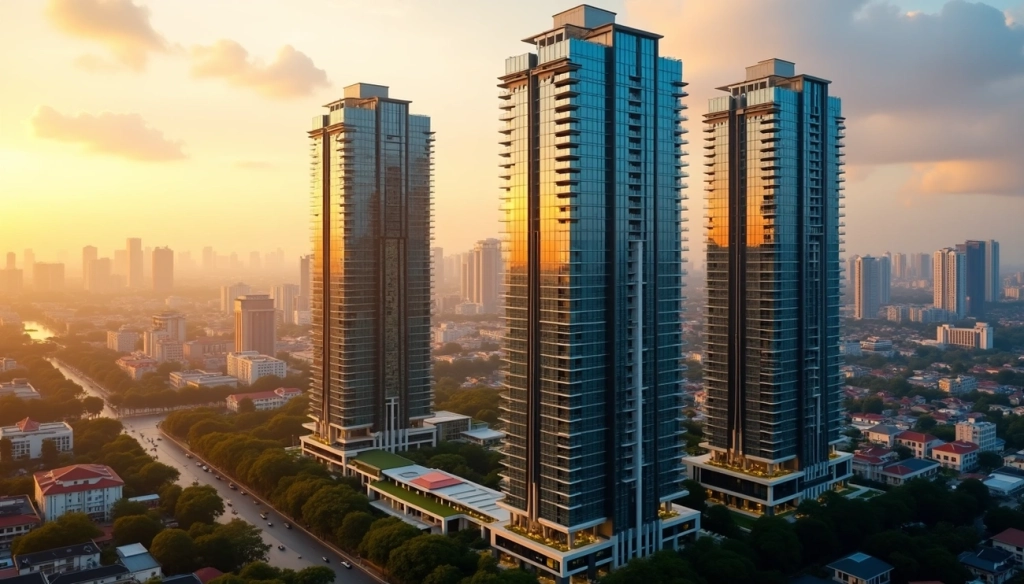

If you’re tracking Bangkok luxury condos, you’ll notice a market change: foreign investors purchased 6,160 condominium units by the end of 2025, representing 23.5% of all developer-sold units with a combined value of THB 29.793 billion. Foreigners bought more units in 2019 (6,558), yet this represented only 12.1% of total sales. Foreign buyers now pay an average of THB 4.836 million for bangkok luxury condos for sale. Thai buyers pay 18% less at THB 4.087 million. International capital is altering how the bangkok luxury condos skyline takes shape.
Local Demand Drops as Foreign Buyers Dominate Bangkok Condo Market
Thai Purchasing Power Fades from Market
Thailand’s residential property market contracted sharply as local buyers withdrew. Nationwide property transfers totaled 227,106 units during the first nine months of 2025, a decrease of 9.3% year-over-year. Transfer values reached THB 617,768 million, down 12.4%. The double-digit contraction in transfer values reflects that purchasing power has not recovered.
High household debt is the biggest problem. The International Monetary Fund reported that household debt reached 88.2% of GDP in the first quarter of 2025. This makes Thailand second only to South Korea in Asia. The Bank of Thailand raised its policy interest rate from 0.5% to 2.5% within a year. Mortgage rates surged and housing demand decreased.
Loan rejection rates hit unprecedented levels across price segments. The Housing Business Association reported rejection rates remained at 39-40% in the third quarter of 2025. Rejection rates reached 70% for properties priced under 3 million baht. The Real Estate Developers Association found the average rejection rate climbed to 40%, with some cases nearly doubling. High debt burdens, unstable income and weak financial histories are the main reasons for rejection.
Consumer behavior shifted so. Most buyers, 82%, now target properties priced at 5 million baht or less. The 1,000,001-3,000,000 baht price range attracted 44% of interest. The 3,000,001-5,000,000 baht segment received 27%. More than one in four consumers (28%) postponed home purchase plans due to economic uncertainty.
Foreigners Account for Record Share of Sales
Foreign buyers now dominate the bangkok luxury condos market as local participation declined. Vichai Viratkapan, acting director-general of the Real Estate Information Center, confirmed the condo market relies on foreign buyers as local demand slowed and has not recovered.
The foreign share of sales increased. Foreign purchases made up 26.6% of total condominium sales in 2025 by value, up from 14.6% in 2019. This shift occurred despite fewer total units purchased. Foreigners bought 6,558 units in 2019 but this represented only 12.1% of developer sales that year.
Bangkok properties connected to public transport systems, near hospitals and educational institutions continue performing well. Properties within business districts also remain strong. Poomipak Julmanichoti, Director and Chief Strategy Officer of Sansiri, noted properties near Chulalongkorn University still sell successfully. Unsold inventory concentrates in peripheral areas and the mass-market segment, particularly units priced at 3 million baht or lower.
Post-Pandemic Recovery Reshapes Buyer Demographics
The pandemic created a dramatic market disruption. Foreign purchases dropped to 1,017 units in 2020, just 16% of 2019 levels. Recovery remained weak in 2021 with only 1,243 units purchased. The situation improved in 2022. Foreign purchases rose to 4,203 units, followed by increases to 5,036 units in 2023, 5,748 units in 2024, and 6,160 units in 2025.
Purchase values took a similar path. The 2025 foreign purchase value of THB 29.793 billion fell short of the 2024 figure of THB 39.640 billion. Weakened economies in Europe, Russia and former Soviet states contributed to this decline. China imposed strict controls on capital outflows.
Secondhand condos gained popularity with foreign buyers during recovery. The proportion of secondhand units transferred to foreigners rose to 40% in the first nine months of 2023. Demand for bangkok thailand luxury condos picked up quickly as borders prepared to reopen. Expatriates returned and investors sought brick-and-mortar assets.
Which Countries Are Snapping Up Bangkok Luxury Condos?
Chinese Buyers Maintain Market Leadership Despite Decline
Chinese investors retained their dominance in the bangkok luxury condos market during the first nine months of 2024. They accounted for 39.7% of total units sold to foreigners (4,386 units) and 39.3% of total transaction value at THB 20.2 billion. This position persisted despite a 14.3% drop in acquisitions to 5,670 units for the full year 2024. Transaction values plunged 22.2% year-over-year.
The decline reflects China’s economic slowdown and stricter capital controls that both governments imposed. Average purchase prices for Chinese buyers stood at THB 4.68 million per unit. Many expatriates working in Bangkok targeted properties around THB 6 million in the Sukhumvit area. A growing segment of ultra-high-net-worth Chinese individuals purchased luxury and ultra-luxury condos in Bangkok’s central business and riverside areas. They treated these acquisitions as trophy assets.
Thailand surged from seventh to first place among countries that attracted Chinese interest in homes priced USTHB 172.12 million or more in 2024. The United States fell from first to seventh. Safety concerns emerged following a high-profile kidnapping incident in early 2025. This sparked worries especially when you have women and families who were thinking about property investment. Demand for luxury residential properties from wealthy Chinese declined earlier in the year due to these security issues.
Myanmar Investors Surge to Second Position
Myanmar nationals emerged as the second-largest group of foreign buyers in 2024 and surpassed Russian investors. Thai condominium transfers to Myanmar buyers tripled in the first nine months of 2024 compared to the same period in 2023. Buyers purchased 1,050 units worth THB 5.46 billion. This figure already exceeded the entire 2023 total of 564 units worth THB 3.7 billion.
The surge accelerated despite a Myanmar government crackdown in April 2024 on Thai condominium purchases. Surachet Kongcheep, Head of Research and Consultancy at Cushman & Wakefield Thailand, noted Myanmar buyers were quick to return to the market. They utilized funds transferred earlier to secure units. Investments rose 65% on a quarterly basis in the July to September period.
Myanmar buyers showed strong purchasing power with an average unit price of THB 5.2 million. This ranked third among foreign buyers behind Indian and American purchasers. Myanmar investors acquired 1,388 units valued at THB 7.036 billion for the full year 2024. This represented a 146.1% increase in unit volume and 89.8% rise in transaction value. Wealthy Myanmar nationals purchased these properties to avoid keeping money in their conflict-affected home country. Preferred price ranges fell between THB 4.99 million and THB 12.05 million. Chiang Mai in northern Thailand attracted interest alongside Bangkok.
Russian and Western Buyers Increase Market Share
Russian investors secured the third position among foreign buyers with 1,079 units worth THB 3.663 billion in 2024. This represented 7% of condominium transfers. Their average unit price of THB 3.39 million marked the lowest among the top five nationalities. This showed a preference for mid- to lower-priced condominiums in tourist destinations such as Pattaya and Phuket for both long-term residences and rental investments.
American buyers constituted 4% of the market with 609 units transferred at a total value of THB 3.027 billion. Units averaged THB 4.97 million. Most American purchases served as vacation homes or investment properties in a market with strong growth potential. Taiwanese buyers boosted their purchases by 57.1% to 836 units, benefiting from Thailand’s visa-free policy. Transaction value increased 47.8% to THB 4.3 billion.
Indian investors stood out for their preference for larger bangkok thailand luxury condos despite a modest 0.4% purchase increase to 260 units worth THB 1.53 billion. Their average unit price reached THB 6.3 million, the highest among all foreign nationalities. Foreign buyers acquired 11,036 units worth THB 51.5 billion nationwide in the first nine months of 2024. This represented a 3.1% year-on-year increase in volume but a 1.5% decrease in value.
Bangkok Luxury Condos Skyline: Where Foreign Investors Are Buying
CBD Commands Highest Foreign Investment Value
Bangkok’s Central Business District captured the highest foreign investment value among all locations. Foreigners purchased 2,015 units worth THB 16.596 billion in 2025. Foreign buyers factored in 44.2% of all condominium sales in the CBD and represented 32.7% of the total transaction value in that location. The average purchase price reached THB 8.236 million per unit. This reflects the premium positioning of properties in this area.
The CBD absorbed 55.7% of total foreign condominium investment in Bangkok and surrounding areas, which totaled THB 29.793 billion. This concentration demonstrates that foreign buyers prefer the city center. They conduct business and reside in areas with complete infrastructure networks. Expressways and urban rail lines provide continuous connection throughout the district. The CBD functions as Bangkok’s main shopping and entertainment hub. This makes daily life more convenient for international residents.
Ratchada-Lad Phrao Area Sees 80% Foreign Ownership
The Ratchada-Lad Phrao area recorded the highest unit volume among foreign buyers. Foreign investors purchased 2,089 units out of 2,603 total units sold and represented 80.3% of all sales. This percentage exceeds the legal 49% foreign ownership quota for condominiums. It suggests involvement of nominee companies or transactions conducted through Thai nationals. Chinese buyers dominated this area. Their attention is drawn to Chinese communities in nearby Huai Khwang and Ratchadaphisek neighborhoods. Condominium developments in this location target foreign investors as their main market.
Foreign purchases in Ratchada-Lad Phrao reached THB 7.144 billion and constituted 72.2% of the total condominium transaction value in that area. But the average unit price stood at only THB 3.42 million. This is lower than the average paid by Thai buyers. This price point creates direct competition with local consumers seeking affordable housing options. The area benefits from dual MRT station access. Properties are located just 25 meters from Ratchadaphisek MRT on the Yellow Line and 245 meters from Lat Phrao MRT on the Blue Line.
On Nut-Suvarnabhumi and Bang Na Attract Airport-Proximity Seekers
The On Nut-Suvarnabhumi corridor emerged as another prominent location for foreign buyers. They purchased 778 units and represented 26.2% of all condominium sales in that area. The total transaction value reached THB 2.919 billion and factored in 32.8% of the area’s total condominium value. Foreign buyers paid an average of THB 3.752 million per unit. This area extends from Sukhumvit Road through Watthana and Khlong Toei districts. It offers quality residential locations with BTS Skytrain connectivity and convenient access to Suvarnabhumi International Airport.
The Bang Na-Thepharak area attracted 689 foreign-purchased units and represented 20.7% of total sales in that location. The transaction value totaled THB 1.498 billion. The average purchase price was THB 2.174 million per unit. Bang Na’s appeal stems from its connection to the Eastern Economic Corridor via Bangna-Trad Road. This positions it as a residential hub for expatriates, investors and young professionals. The area hosts major shopping centers including Mega Bangna, Central Village and Central Bangna. Government infrastructure plans support continued development. The expansion of Suvarnabhumi Airport across five phases and the new LRT Bangna-Suvarnabhumi line featuring 14 stations are part of these plans. Land prices in Bang Na averaged 200,000 to 500,000 baht per square wah in 2024.

Luxury Villa in Mabprachan Pattaya for Sale

1 Bedroom Cozy Beach Sea View Condo for Sale
The View Cozy Beach Residence, Pattaya 7 Alley, Pattaya City, Bang Lamung District, Chon Buri, Thailand
2 Bedroom Atlantis Condo Resort for Sale
Atlantis Condo Resort Pattaya, Jomtiensaineung Road, Pattaya City, Bang Lamung District, Chon Buri, Thailand
Arom Wongamat Condo For Sale
Pho Samphan Alley, Pattaya City, Bang Lamung District, Chon Buri 20150, Thailand


