
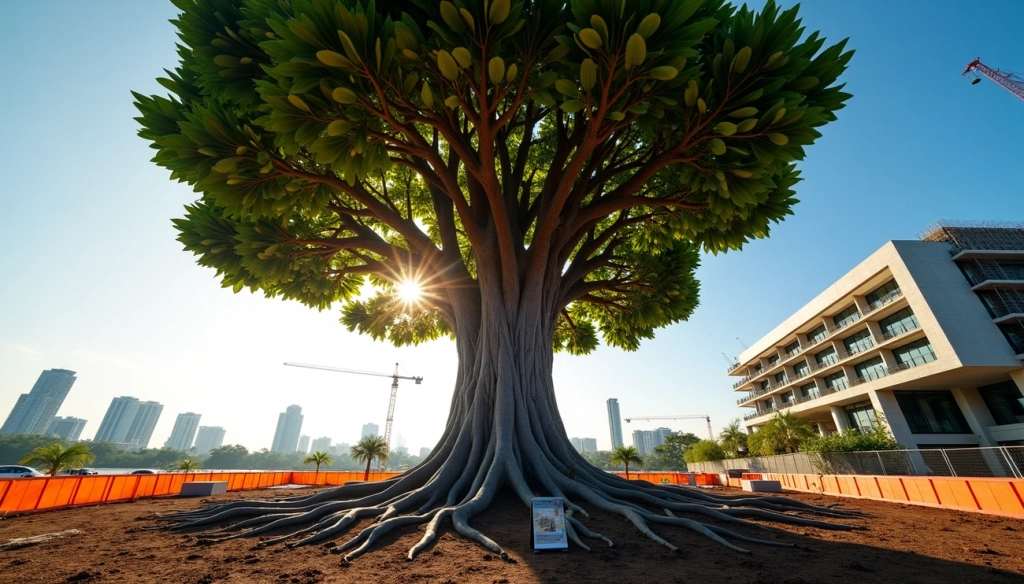
We witnessed eco-friendly resort development take an unprecedented turn when a prime Pattaya property owner halted construction plans to preserve a single century-old Yang tree at Central Pattaya’s most strategic intersection. The 600 million baht project centers around a towering native specimen whose canopy stretches to the height of a 15-storey building. This decision signals a fundamental change in Thailand’s coastal development priorities, where rapid urbanization has conflicted with environmental preservation historically. The development adopts a nature-first philosophy. It designates 30 percent of the site as high-biodiversity green area and develops the remaining 70 percent around it in an eco-friendly manner. This sets new standards for eco-friendly resorts throughout the region.
Developer Halts Prime Pattaya Construction to Save Century-Old Yang Tree
The Hereditary Plot at Central Pattaya’s Most Strategic Corner
Sirithon Thamrongnawasawat, known as Khun Jeep among those close to her, owns a land parcel that her family has stewarded for generations in Pattaya’s urban core. As the youngest sister of Dr Thon and Dr Thun Thamrongnawasawat, she inherited the plot at the intersection of Central Pattaya Road and Pattaya Sai 2 through a lineage tracing back to Luang Thamrongnawasawat. Property analysts recognize the site as one of the most positioned land parcels on the Eastern Seaboard.
The family held this plot for generations and resisted the pressure that transformed surrounding areas into high-density commercial developments. Plans emerged to activate the site for the first time, but not through the conventional approach that has dominated Pattaya’s development narrative for decades.
The location’s commercial potential makes the decision to center the project around a single tree carry substantial financial weight. The total investment reaches approximately 600 million baht when you factor in land value and construction costs. This figure underscores a choice to prioritize eco-friendly resort development over immediate returns.
Sirithon sees Pattaya’s progress beyond its tourism-dependent identity. “I believe Pattaya will be a secondary city,” she stated and explained her rationale behind the investment. “It is the nearest seaside city to Bangkok that has been developed as both an urban center and a place to rest. It is suitable for people of every age, and it has the beach, the clean air and the community—the kind of city that supports the way people want to live and work in the future”.
Why This Tree Matters More Than Revenue
The Yang tree anchoring this development holds a difference as one of the last remaining specimens of this native Pattaya species within the city. Glass-and-steel towers have spent decades displacing anything unable to generate quick returns across Pattaya’s urban landscape. This tree survived that transformation.
The specimen stands as original to the land and predates the city’s modern development. It serves as a living record of what Pattaya looked like before urbanization reshaped the coastline. The tree was not transplanted or installed as a landscape feature—it grew from this exact location.
The architectural challenge posed by the tree’s dimensions influenced the project approach. Building around existing mature root systems while you maintain the tree’s health requirements demands conservation-led architecture rather than standard development practices. This constraint became the defining feature of the project rather than an obstacle to overcome.
The decision carries weight when you get into Pattaya’s recent development history. A 50-year-old yang na tree (Dipterocarpus alatus) standing outside Siam Commercial Bank near the intersection of Central and Second Roads was cut down in January after dying while still rooted. Deputy Mayor Manote Nongyai confirmed the tree’s removal and noted it posed danger of falling. The city’s Environment Department converted the wood to fertilizer.
This precedent makes the choice to halt construction plans and redesign around the surviving Yang tree significant for eco-friendly resorts moving forward. The site transforms from maximum buildable potential to a model where nature dictates the development parameters, not the other way around.
What Makes the Yang Tree So Rare?
Last Native Species Standing in Modern Pattaya
The Yang tree belongs to Dipterocarpus alatus, a species that once dominated the coastal forests of what is now Pattaya. Few specimens of this native species remain within city limits. The tree at Central Pattaya’s intersection stands as one of the last representatives of the area’s original ecosystem. Most Yang trees disappeared decades ago to make room for hotels and shopping complexes. This specimen survived through family stewardship rather than municipal protection programs.
The species holds no status as an exotic transplant or curated landscape feature. This difference matters in sustainable resort development. The tree represents genuine ecological heritage rather than decorative urban forestry. Other Yang Na trees documented throughout Thailand demonstrate the species’ cultural and environmental significance. A celebrated Yang Na Yai tree on Koh Phangan draws visitors for its historical presence and immense proportions.
Urban expansion eliminated most native vegetation in Pattaya before environmental consciousness shaped development decisions. The survival of this single tree becomes a biological anomaly in an area where concrete and glass replaced natural landscapes over five decades.
A Living Record of Pre-Development Coastline
The tree grew from this exact location and predates every structure surrounding it. Its presence documents what Pattaya’s landscape contained before tourism infrastructure transformed the coastline into a commercial district. The specimen serves as a living record of pre-development conditions. It offers a way to learn about the native flora that characterized this region before urbanization.
The tree was original to this land. It established its root system when Pattaya existed as a fishing village rather than a resort destination. This temporal anchor provides context that no historical photograph or municipal archive can replicate. The root structure beneath the visible canopy extends across decades of growth and embeds itself into soil layers that remember a different Pattaya.
Dipterocarpus alatus specimens can live for hundreds of years and accumulate not just height but historical significance. The species’ longevity means this tree witnessed Pattaya’s entire transformation from quiet coastal settlement to major urban center. Its continued survival through that transition makes it a botanical witness to rapid environmental change.
Height and Canopy Span Challenge Modern Architecture
The tree’s canopy stretches to the height of a 15-storey building. This creates immediate architectural constraints for any sustainable resort development sharing the site. Dipterocarpus alatus can reach 40-50 meters in mature specimens. This places the tree in the upper range of the species’ growth potential. Such dimensions dictate building placement, foundation depths and structural approaches across the entire property.
Building around existing mature root systems requires conservation-led architecture that prioritizes the tree’s biological needs over construction efficiency. Root zones extend far beyond the visible trunk and often span distances equivalent to the canopy width. Foundation work must account for underground root networks that cannot be disturbed without risking the tree’s stability and health.
The vertical dimension compounds these challenges. A canopy reaching 15 storeys means any adjacent structures must think about sunlight access, wind patterns and spatial relationships that accommodate rather than compete with the tree’s presence. Standard high-rise development models fail when a protected specimen occupies prime buildable space and demands design modifications at every planning stage.
This architectural reality explains why the 30-70 nature-first philosophy emerged as the only viable approach for sustainable resorts centered around heritage trees. The tree’s physical requirements define what can be built and where. They establish environmental parameters before economic considerations enter the equation.
Find your dream Property in Pattaya & Thailand

Luxury Villa in Mabprachan Pattaya for Sale
- ฿16,900,000
- Beds: 4
- Baths: 6
- 378 Sqm
- Pool Villa

1 Bedroom Cozy Beach Sea View Condo for Sale
- ฿4,520,000
- Bed: 1
- Bath: 1
- 69.51 Sqm
- Condo

2 Bedroom Atlantis Condo Resort for Sale
- ฿3,990,000
- Beds: 2
- Baths: 2
- 72.88 Sqm
- Condo

Arom Wongamat Condo For Sale
- ฿13,480,000
- Bed: 1
- Bath: 1
- 47.85 Sqm
- Condo
How Project Yang Redefines Sustainable Resorts Development Model
30-70 Nature-First Design Philosophy
The guiding philosophy inverts conventional sustainable resort development priorities. It designates 30 percent of the site as high-biodiversity green area while developing the remaining 70 percent around it. This allocation framework places ecological preservation at the foundation of planning decisions rather than treating green space as a secondary amenity. So the approximately 2 rai site commits only half its area to built structures.
The buildable portion accommodates a mid-scale hotel containing between 80 and 120 rooms alongside a mixed-use community component. The remaining land transforms into preserved green open space, centered on the Yang tree itself. This model reflects a broader movement toward integrating urban space with living landscape. It builds a city within a garden rather than inserting a garden within a city.
Sirithon foresees programming that operates as pet-friendly and multigenerational, defined by everyday togetherness where people of different ages and backgrounds share the same environment. The calendar has wellness activities, community sports, and longevity-focused events designed around rhythms of people who live in the area, not those passing through. This sustainable resort development places nature at the center of every visitor’s experience rather than positioning architecture as the primary draw.
Building Around Roots: Conservation-Led Architecture
The development team engaged one of Thailand’s leading arborists to create a detailed conservation plan for the Yang tree. This plan maps precise zones across the site where construction remains possible without compromising the tree’s root system, canopy structure, or long-term health. The approach reflects a foundational belief that protecting an ancient tree begins with building the community that will understand and care for it.
Root protection areas extend radially from the trunk. You calculate them by taking the tree’s height and multiplying by one and a half. For a specimen that reaches 15-storey heights, this creates substantial no-build zones across the property. Building within these protected areas risks severing major roots during groundworks, so it affects the tree’s water absorption capacity and overall stability during strong winds.
Specialized construction techniques address these constraints. Piling represents the most common approach around tree roots and affects only a small zone of the root protection area. An air spade first exposes the root network. This enables precise site setting for pile placement that minimizes damage. The piles then support ground beams positioned above existing ground level to hold the building structure.
Alternative foundation systems employ screw piles inserted at appropriate locations to avoid any effect on tree roots. This foundation type requires no heavy machinery or methods that could harm the site. It offers a smoother technique to implant buildings within the maze of underground root systems. The philosophy of “form follows the existing” guides architectural decisions, where structures adapt to respect and integrate trees already present rather than clearing vegetation for buildings.
Community Green Space Replaces Half the Buildable Land
The decision to preserve half the site as community green space carries direct financial implications against maximum development potential. Similar projects in markets worldwide demonstrate that ecotourism grows at nearly 20 percent each year, with over 70 percent of travelers prioritizing environmentally responsible accommodations. This move suggests nature-based sustainable resorts may generate stronger long-term returns than high-density alternatives.
The programming reflects this community-first approach through spaces designed to enable daily interaction rather than commercial transactions. The development creates what sustainable resort development literature describes as “less structure, more experience”, where the site functions as a shared environment for residents and visitors operating within the same ecosystem. This model positions green space not as leftover land but as the primary asset that defines property value and user experience.
Strategic Location Amplifies Conservation Impact
Proximity to Aquatique District Mega-Project
The Yang tree conservation site sits right next to one of Thailand’s largest hospitality developments currently in planning stages. Aquatique District Pattaya represents a 100 billion baht mega-project from Asset World Corporation. The project sits in the center of Pattaya Bay between Beach Road and Second Road near the Hard Rock Hotel. The development blueprint has five major hotel brands: JW Marriott, The Autograph Collection, Marriott Marquis with convention center, Kimptons Hotel, and Vignette Collection.
Asset World Corporation’s portfolio across Thailand shows they can handle projects of this magnitude. The Aquatique development has a massive shopping mall, an aquarium facility, Legoland, Peppa Pig amusement park, and a health and wellness center. This concentration of lifestyle amenities makes Central Pattaya a focal point for tourism and residential markets.
The sustainable resort development at Project Yang benefits from this adjacency. Properties near large-scale lifestyle destinations usually see renewed investor interest as the area gains greater visibility and long-term value. The conservation-first model contrasts with the Aquatique approach. It offers an alternative development philosophy within walking distance of one of the region’s most intensive commercial projects.
Transit-Oriented Position Along Planned Green Line Monorail
Pattaya plans to construct its Green Line monorail as the pilot route. The route will connect the future high-speed rail station to Bali Hai Pier across 13 stations. The 9.9 km line enters the Environmental Impact Assessment phase, with submission completed to review. Construction timelines place the Green Line in the first phase spanning 2021-2026.
The monorail system uses a public-private partnership framework. Environmental Impact Assessment officials surveyed potential station sites along the proposed route. This would serve as the city’s pilot mass transit line. The project advances through the National Economic and Social Development Council to review cost-effectiveness before Cabinet consideration.
Transit-Oriented Development planning came from collaboration between Pattaya City, the Eastern Economic Corridor Policy Committee, and the World Bank. These TOD initiatives use public transit hubs to combine residential, commercial, and public service developments around station areas. The strategy matches Thailand’s Sustainable Grassroots Economic Development Project. The goal is to boost local economies through strategic urban planning.
The Yang tree project’s Central Pattaya location places it along this planned transit corridor. Sustainable resorts near mass transit infrastructure capture professionals seeking reduced commute dependencies. The Green Line wants to transform Pattaya into a smart, liveable tourism city. This vision matches Project Yang’s community-focused programming perfectly.
EEC Infrastructure Raises Regional Development Standards
The Eastern Economic Corridor covers three provinces: Chachoengsao, Chonburi, and Rayong. The area spans 13,000 square kilometers. The development initiative drives Thailand 4.0 policy objectives and transforms the country toward an innovative and value-based economy. The Action Plan covers 77 infrastructure projects worth a total of 337 billion baht.
Major projects have U-Tapao Airport expansion to handle 60 million travelers per year, Map Ta Phut and Laem Chabang seaports development, and high-speed railways. The EEC Policy Committee projects the zone will attract investment of 500 billion baht per year from 2022 to 2026. Annual GDP should rise by 1.5 percent during this period.
Pattaya leads this transformation as a residential and strategic hub within Thailand’s most ambitious industrial corridor. The high-speed rail link connecting Bangkok’s airports with U-Tapao compresses travel times. It brings Pattaya into the daily operational footprint of the EEC. Executives and technical specialists in advanced manufacturing and digital infrastructure increasingly see Pattaya as a viable long-term base rather than a weekend destination.
Project Yang’s conservation model becomes more significant given these points. The sustainable resort development operates within an infrastructure context that needs higher environmental standards and liveable urban design. The 600 million baht investment in nature-first development signals confidence. EEC-driven growth will reward projects that prioritize quality of life over density maximization.
Neighboring Developers Join Tree Conservation Movement
Collaborative Green Space Creation
Real estate developers in Thailand of all sizes have moved toward tree conservation as part of corporate social responsibility programs, especially when you have projects like Yang tree preservation. Bangkok property developers now invest in urban tree conservation within their project footprints in a similar way.
Magnolia Quality Development Corporation created The Forestias, a program setting aside 3 rai out of 300 to conserve urban trees on a major residential construction project along Bang Na-Trat Road. The initiative provides arboriculture service and tree maintenance free of charge to the public through a specialized Forest Rescue Team trained in professional tree care. The company allocated 70 million baht in funding and expects to rescue between 1,000 and 2,000 trees.
Surin Warachun, an ecological expert working for The Forestias, outlined the process. Team members visit trees that need special care, assess their condition, identify owners, and determine whether trees can be nursed on-site or need relocation to the project’s nursing facility. Pattaya City pursued similar collaboration to conserve mangrove forests not long ago and engaged the Department of Marine and Coastal Resources, Harbor Department, Department of Fisheries, EGAT, TAT, and other relevant agencies. The collective effort wants to restore and complete the mangrove forest while harmony within the ecosystem is maintained.
Relocating Mature Trees from Adjacent Sites
CH Karnchang’s tree relocation project demonstrates how infrastructure developers integrate conservation into large-scale construction. The company transplanted 127 trees from the MRT Purple Line Project construction site to suitable nurturing locations. Each tree went through a full assessment before relocation to ensure smooth transition without harming growth. Species moved included Pterocarpus indicus, Albizia saman, Intsia bijuga, Mangifera indica, Aegle marmelos, Millingtonia hortensis, Terminalia catappa, Plumeria, Shorea roxburghii, and Saraca indica.
Professional tree relocation services employ crane lifting techniques for mature specimens. Landscaping teams prepare trees by clipping large branches and cutting away roots before they secure them to crane units for transport to new landscape positions. The trees receive replanting in areas where they can grow and flourish again.
Building Community Before Buildings
The first tree relocated to The Forestias nursing facility came at the owner’s request: a 20-year-old pink trumpet that needed temporary relocation during home renovation. The second involved a 27-year-old rain tree from Soi Lat Phrao 110 whose owner reported it annoyed neighbors, followed by a mango tree from Soi Lat Phrao 71.
This approach prioritizes community relationships over immediate construction timelines. Establishing networks of care and shared responsibility precedes physical structures for sustainable resort development. Project Yang follows this model by positioning conservation as a mutually beneficial effort rather than an isolated corporate decision.
What This Signals for Pattaya’s Development Future
From Tourist Hub to Liveable Smart City
Project Yang investment arrives as Pattaya accelerates its identity change from a single-focus tourist town into a dynamic hub for quality living. City planners work aggressively to shed the “Sin City” label. They rebrand Pattaya as a prime destination for families through world-class theme parks like Ramayana Water Park and Columbia Pictures Aquaverse. Pattaya positions itself at the indisputable core of the Eastern Economic Corridor, bringing massive investment to create over 100,000 new high-skilled jobs in robotics, aviation, digital tech and advanced services.
The EEC infrastructure has high-speed rail connecting Pattaya to Bangkok and its main airports, upgraded U-Tapao Airport becoming a major international hub and better motorways for quick travel. This connectivity makes sustainable resort development viable for business professionals who just need functioning cities with top-tier infrastructure beyond beach access. Pattaya City reviews development plans continuously to strengthen long-term planning and guide the city toward sustainable growth. Officials emphasize updating frameworks to support growth while ensuring balanced urban development. The third Local Development Plan covering 2028-2032 defines strategies for infrastructure, economic development, public services and community well-being.
Remote Work Migration Just Needs Different Urban Design
Digital nomads choosing Pattaya as their base create a noticeable effect on the city’s real estate market, especially when you have rental needs and coworking spaces. Remote workers seek modern, furnished apartments with good internet connections and proximity to coworking spaces. This leads to notable rises in short- to medium-term rentals in Jomtien, Pratumnak Hill and Central Pattaya. Properties catering to this demographic command higher rental rates, making them attractive investments. Developers now think about incorporating workspaces and communal areas into new sustainable resort projects.
600 Million Baht Bet on Nature-Based Returns
Sirithon’s confidence in nature-first sustainable resort development reflects broader evidence that integrating nature-based solutions into real estate creates economic value. It increases esthetic quality and supports wellbeing. Studies show amenities like rooftop gardens alone boost property value by approximately 11 percent. More than half of global GDP depends moderately or highly on nature. The 600 million baht investment signals recognition that nature-based returns may exceed conventional high-density approaches for sustainable resorts targeting the remote-working population that just needs different urban design.
Conclusion
We observed a fundamental change in coastal development priorities through this single conservation decision. The 600 million baht investment demonstrates that green resorts can prioritize ecological heritage over maximum density. The 30-70 nature-first philosophy establishes a replicable framework for developers in Pattaya and beyond. Just as important, neighboring developers now join this conservation movement and relocate mature trees while creating shared green spaces. The project positions itself within the EEC infrastructure transformation, where remote workers and business professionals just need liveable urban environments rather than purely commercial districts. This Yang tree stands as both botanical witness and blueprint for Pattaya’s progress toward truly green development.


